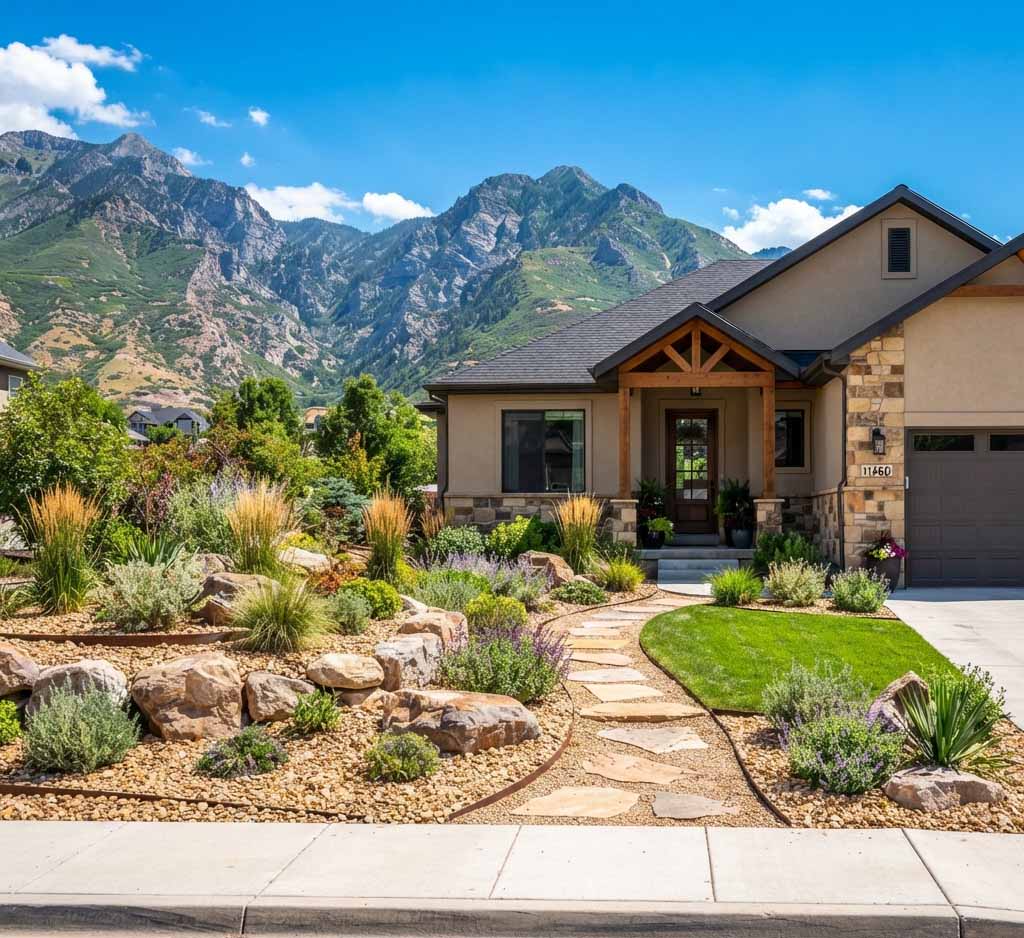
If you own a sloped lot in Sandy, Utah, the single most important thing to do before you install anything — sod, a patio, an irrigation system, a single shrub — is get the slope and drainage assessed first. Sandy’s terrain changes dramatically from one neighborhood to the next, and a landscape plan that works two streets over can fail completely on your lot. Before you pick plants or call a sod company, know your grade, know where your water goes, and know whether you actually need a retaining wall or just better grading.
Why Sandy’s Terrain Makes This Step Non-Negotiable
Sandy isn’t one terrain — it’s several. Head west toward the Sandy Civic Center and the I-15 corridor, and you’re on relatively flat valley floor with dense clay soil. Head east toward Bell Canyon, Hidden Valley, Alta Canyon, and the Lone Peak corridor near the mouths of Big and Little Cottonwood Canyons, and the ground climbs fast — foothill lots here regularly carry grade changes of ten to fifteen feet from the front of the property to the back. In between, established neighborhoods with mid-century ramblers sit alongside larger contemporary homes built into the bench, often on split-level lots designed around the slope rather than in spite of it.
That range matters because a landscaping plan is only as good as the site assessment behind it. A flat central-Sandy lot with clay soil handles water very differently than a rocky foothill lot near the canyon mouths. Skip the assessment and you risk one of two expensive outcomes: installing a landscape that can’t handle runoff and erodes or floods within a season, or over-building retaining walls and drainage infrastructure you didn’t actually need.
Step 1: Get Your Slope and Drainage Professionally Assessed First
Before a single yard of sod goes down or a plant goes in the ground, a landscape designer should walk your property and map three things: the direction water naturally moves across your lot, where it currently pools or erodes, and how much the grade changes from your foundation to your property line. On a foothill lot, that assessment also has to account for how water moving downhill from neighboring properties above you will interact with your own drainage plan — a factor flat-lot landscaping in central Sandy doesn’t have to consider at all.
This is also the point where Sandy City’s grading and stormwater requirements come into play. Land-disturbing work above a certain size threshold requires a grading and drainage permit, and that permit process asks for existing and proposed elevations, slope direction, and — for larger retaining walls — engineering detail on how the wall handles the load behind it. Skipping this step doesn’t just risk a design problem; on a large enough project, it risks a compliance problem with the city.
A thorough assessment also looks at what’s happening below the surface, not just on top of it. Soil composition changes noticeably across Sandy — the dense clay common in central and west Sandy compacts and drains slowly, while the rockier, looser soil higher up toward the foothills drains fast but holds far less structure on its own. Two lots with the same visual slope can need completely different grading and drainage solutions once soil type is factored in, which is exactly why a generic landscaping plan pulled from a neighboring city rarely translates well to a Sandy hillside property.
The output of a proper assessment isn’t a plant list — it’s a grading plan. Everything else in your landscape design, from where a patio can go to which plants will actually survive, should follow from that grading plan, not the other way around.
Step 2: Figure Out Where You Actually Need a Retaining Wall
Not every slope needs a retaining wall, and not every retaining wall needs to be the same kind of wall. The right answer depends on how steep the grade is, how much usable flat space you’re trying to create, and what’s sitting at the top or bottom of the slope — a driveway, a foundation, a neighbor’s fence line.
| Slope Situation | Typical Approach | What Drives the Decision |
| Gentle grade (under ~1 ft drop per 10 ft) | Ground cover planting, soil amendments, light contouring | Erosion risk is low; goal is stabilization, not structure |
| Moderate grade with a low spot or erosion channel | Terracing, swales, French drains | Water needs to be redirected, not just slowed |
| Steep grade near a foundation, driveway, or property line | Engineered retaining wall, tiered wall system | Structural load, soil pressure, and long-term stability are at stake |
| Foothill lot with 10+ ft of elevation change | Cut-and-fill grading plan plus tiered retaining walls | Scale of the grade change requires a full engineered plan, not a single wall |
Sandy’s foothill lots near Bell Canyon and the Cottonwood Canyon corridor frequently fall into that last category, where tiered wall systems — sometimes built in natural stone to match the canyon setting — turn a steep, largely unusable backyard into a series of level spaces for a patio, garden beds, or a play area. A flatter lot in central or west Sandy is far more likely to need only the second or third approach, which is a very different project in scope and timeline.
Step 3: Sequence the Work So You’re Not Paying to Redo It
One of the most common — and most expensive — mistakes on a sloped Sandy lot is installing landscape features out of order. Sod, planting beds, and irrigation lines are the last things that should go in, not the first. The correct sequence looks like this:
- Grading and drainage — establish final elevations, swales, and any cut-and-fill work
- Retaining walls and hardscape structure — build any walls, steps, or terracing that depend on the finished grade
- Irrigation — lay lines and heads based on the final grade and hardscape layout, not the original slope
- Planting and sod — install last, once the grade, structure, and water delivery are all locked in
Homeowners who install sod or plant beds early, then discover a drainage problem later, often end up tearing out and redoing work that a proper sequence would have avoided entirely. On a sloped Sandy lot, this sequencing matters even more than on a flat one, because every later step depends on the grade being correct before it starts.
This is also where phasing a project over multiple seasons can work in your favor rather than against it, as long as the sequence stays intact within each phase. A homeowner might handle grading and wall construction one season and hold off on planting until the following spring — that’s fine. What causes problems is skipping ahead within a single phase, like laying sod before the grading behind it is finished, just to make quicker visual progress.
Step 4: Match Plants and Materials to Sandy’s Elevation and Soil
Plant selection on a slope isn’t just about looks — the right plants do real structural work holding soil in place between rainstorms and snowmelt. What works well depends heavily on which part of Sandy you’re in. Foothill lots at higher elevation near the canyon mouths deal with rockier, faster-draining soil and more exposure to wind and winter conditions. Central and west Sandy lots tend to have denser clay soil that drains more slowly and holds water longer after a storm.
For slope stabilization specifically, native and drought-tolerant plants tend to outperform anything else because their root systems are built for exactly this job:
- Utah serviceberry and native scrub oak — deep-rooted, well-suited to foothill-edge properties
- Creeping phlox and ice plant — low groundcovers that lock down soil on gentler grades
- Apache plume and rabbitbrush — shrubs that hold their own on steeper sections
- Penstemon and other native perennials — low-maintenance, low-water, and well-adapted to Sandy’s elevation swings
Materials matter too. Natural stone tends to suit the foothill aesthetic and holds up well structurally, while engineered block systems offer more flexibility for taller, code-compliant retaining walls. The right choice depends on the wall height, the load it’s carrying, and the look you’re going for — not just cost.

Ready to Plan Your Sloped Lot the Right Way?
Don’t guess on grading, drainage, or retaining walls — get a site-specific plan before you spend a dollar on plants or materials.
Schedule an on-site design consultation with Millburn Lawn & Landscape and get a grading and drainage plan built specifically for your Sandy property.
Call (801) 810-5452 today.
Frequently Asked Questions
How do I know if my Sandy yard needs a retaining wall or just better grading?
It comes down to how steep the grade is and what’s at risk if water isn’t redirected. A gentle slope with no erosion or standing water usually just needs better grading and ground cover. A steep slope, or one near a foundation, driveway, or property line, usually needs a structural wall. A site assessment settles the question — guessing usually leads to over-building or under-building.
Do I need a permit to grade my yard or build a retaining wall in Sandy?
Land-disturbing work above a certain size, and taller retaining walls in particular, typically require a grading and drainage permit through the city. Requirements depend on the scope of the project, so it’s worth confirming before work starts rather than after.
What’s different about landscaping a foothill lot near Bell Canyon or Hidden Valley versus a flat lot in central Sandy?
Foothill lots usually have significant elevation change, rockier soil, and more exposure, which often means retaining walls and engineered grading. Central and west Sandy lots are typically flatter with denser clay soil, so the priority shifts toward drainage and soil amendment rather than structural walls.
Can I install sod or a patio on a sloped yard without addressing drainage first?
You can, but it’s a common source of expensive rework. Grading and drainage should be finalized before sod, planting, or hardscape goes in — installing out of order often means redoing work once a drainage problem shows up.
How steep does a slope need to be before it needs professional grading?
There’s no single number that applies everywhere, because it depends on soil type, what’s downhill from the slope, and how the water is currently moving. That’s exactly why a site-specific assessment matters more than a rule of thumb.
What plants hold soil best on a Sandy hillside?
Native, deep-rooted options like Utah serviceberry, scrub oak, and rabbitbrush do the most structural work, while low groundcovers like creeping phlox handle gentler sections. The right mix depends on your slope’s grade, sun exposure, and soil type.