Landscape Design Around Mature Trees in Holladay, UT
You can redesign a Holladay yard without losing its mature trees, but the design has to start with the trees, not the patio. That means mapping each tree’s root zone before deciding where hardscape goes, choosing plants for the shade those trees actually cast, changing irrigation so it waters roots without soaking trunks, and checking whether any tree is protected under Holladay’s Tree Preservation Ordinance before anything comes out. Get those four things right and the canopy that makes your street feel like Holladay stays healthy through construction and long after.
Holladay takes its trees seriously. The city’s tree committee formed in 2011 as part of earning Tree City USA status, and after residents on Walker Lane watched more than 20 trees come down on a neighboring property in 2017, the city adopted a tree canopy ordinance in 2018. Many of the oldest trees in Holladay stand in backyards along Cottonwood Lane, near Big Cottonwood Creek, and through neighborhoods like Sunnyside Heights and Lakewood. This guide covers how landscape design around mature trees works in practice, from root protection to plant choices to irrigation.
Why Landscape Design Around Mature Trees Works Differently in Holladay
In many cities, whether a big tree stays is entirely the owner’s call. In Holladay, a protected tree generally needs a permit to come out, with exceptions for trees that are damaged, dead or dying, essential to development, or a safety hazard. The application asks for a Tree Canopy Sustainability Plan that inventories the canopy and plans for replacement where removal is approved.
For design, that changes the order of operations. The trees go on the plan first, along with their root zones, and the patio, paths, and beds get arranged around them. It also means a design that assumes a tree will be removed carries risk until the permit question is answered. If any tree on your lot is in question, start that conversation with the city’s Community and Economic Development Department before the layout is final.
Properties in the Foothills and Canyons Overlay Zone on the east side of the city carry additional tree and vegetation protection standards, so confirm whether your lot falls inside it.
Protecting Root Zones During Landscape Construction
When a mature tree declines after a landscape project, construction is usually the cause. The damage happens below ground, and it may not show for a year or more. The common culprits:
- Trenching for irrigation, lighting, or gas lines that cuts through roots.
- Soil compaction from equipment, deliveries, and foot traffic, which squeezes out the air roots need.
- Grade changes. Even a few inches of fill over a root zone can suffocate roots.
- Stockpiling soil, gravel, or pavers under the drip line.
A widely used arborist rule of thumb treats about one foot of radius for every inch of trunk diameter as a tree’s critical root zone, and most feeder roots sit in the top foot or two of soil. That’s why design choices near a big tree lean toward methods that disturb as little soil as possible:
- Decks on pier footings instead of a slab patio, so only a few holes go into the root zone.
- Permeable pavers or flagstone on a shallow base where a patio has to sit near a tree, rather than deep excavation.
- Boring under roots for irrigation and lighting lines instead of open trenching.
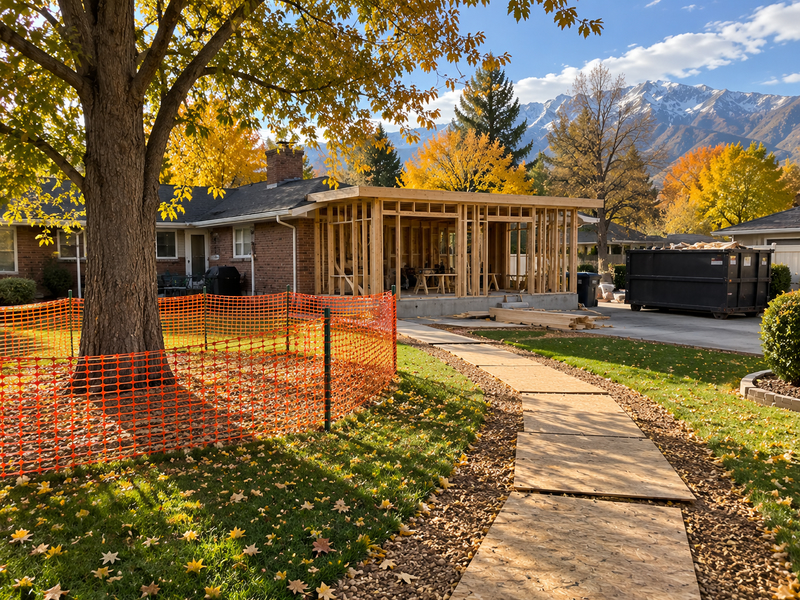
- Temporary protection fencing around root zones during construction, with no parking or material storage inside it.
For large or valuable trees, bring in an ISA-certified arborist to assess health and set protection limits before the plan is final. A design-build team can then build to those limits.
Choosing Plants for Holladay’s Shaded Yards
Under an established canopy, two things work against new plants: shade and root competition. That’s why lawn thins out under big maples and spruces no matter how much it’s watered. Fighting it usually means more water, more fertilizer, and the same thin grass.
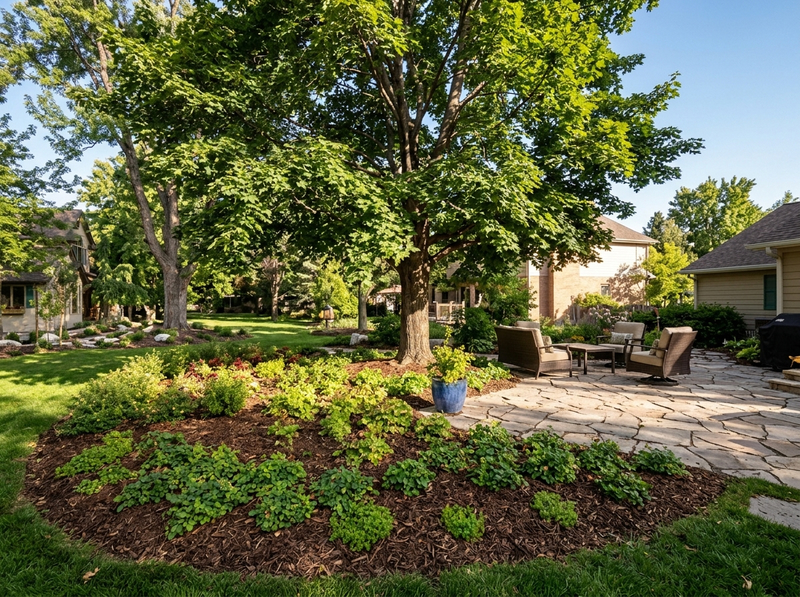
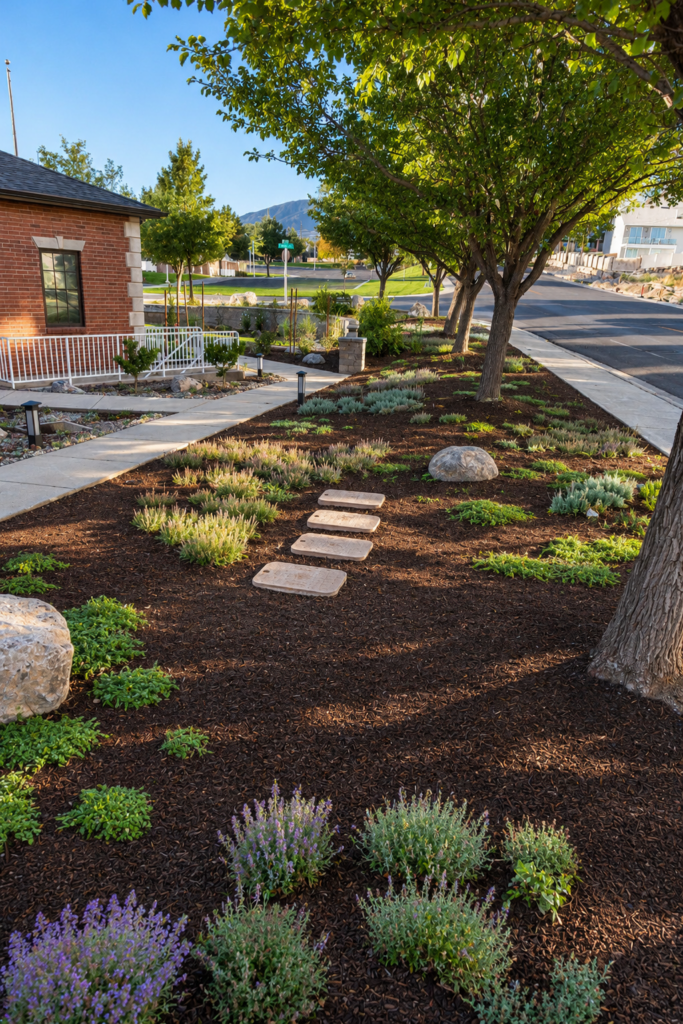
A better approach is to replace struggling turf under the canopy with plants suited to those conditions, plus a layer of wood mulch that works like a forest floor. Options that hold up in Salt Lake Valley shade include:
- Creeping Oregon grape (Mahonia repens). A native evergreen groundcover that handles dry shade.
- Barrenwort (Epimedium). One of the toughest choices for dry shade under trees.
- Coral bells (Heuchera). Foliage color for partial shade.
- Bergenia. Bold evergreen leaves for bed edges.
- Sweet woodruff. A low, spreading groundcover for lightly shaded spots with some moisture.
- Hellebores. Early-season blooms in shaded beds.
Plant smaller sizes in pockets rather than tilling the whole bed. Tilling under a mature tree cuts the same feeder roots the design is trying to protect. Keep mulch a few inches away from the trunk and never pile it against the bark.
Irrigation for Landscape Design Around Mature Trees
This is the step most homeowners don’t think about, and in Holladay it matters. Many of the city’s big trees have spent decades drinking from lawn sprinklers, and their roots have spread to follow that water. When a lawn gets converted to patio or water-wise beds and the spray zone is shut off, the tree can lose much of its water supply overnight.
A good design plans for that:
- Give trees their own watering, either a dedicated drip zone or bubblers placed out near the drip line, where the active roots are, rather than at the trunk.
- Water deeply and less often so moisture reaches the root zone instead of staying at the surface.
- Keep spray heads off the trunk to reduce bark and crown problems.
- Upgrade to a smart controller that adjusts to the weather. Jordan Valley Water Conservancy District and Utah Water Savers offer controller rebates that many Holladay residents may qualify for, depending on their water provider.
If your older system mixes drip and spray heads on one valve, sort that out as part of the design. Trees, beds, and any remaining lawn each need different watering, and they can’t get it from the same zone.
Making a Shaded Holladay Yard Feel Open and Usable
Big trees can make a backyard feel closed in. A few design moves keep the shade while bringing back light and views:
- Crown raising. An arborist can remove lower limbs in stages to open sightlines toward Mount Olympus without harming the tree.
- Patio placement at the canopy edge. A patio near the outer drip line gets dappled afternoon shade without sitting on the densest roots.
- Lighter hardscape colors that brighten shaded areas.
- Planning for leaf drop. Fine gravel and rock mulch under deciduous trees turn fall cleanup into a chore. Wood mulch and groundcovers let leaves break down in place.
- Planning for cottonwood fluff. Cottonwoods along Big Cottonwood Creek drop seed fluff in late spring, and it collects in pools, water features, and outdoor kitchens. Place those features with that in mind.
These details are what make a yard under a mature canopy feel intentional rather than overgrown.
Landscape design around mature trees in Holladay comes down to sequence: trees and root zones first, city rules second, everything else third. Protect the roots during construction, choose plants that like the shade you have, and give the trees their own water once the lawn changes. Do that, and the canopy that gives Holladay its character stays healthy for the next owners too.
Want to redesign your yard and keep the trees that make it feel like Holladay?
Call Millburn Lawn & Landscape at (801) 810-5452 or request a design consultation at millburnlandscape.com.
We plan around your existing trees from the first site visit, then build with the same company that drew the plan. Licensed and insured (Utah contractor #9608499-5501), serving Holladay and the Salt Lake Valley.
Frequently Asked Questions
Can I put a patio under a big tree in Holladay?
Often, yes, with the right method. Decks on pier footings and permeable paving on a shallow base disturb far less soil than a poured slab. Keep the patio out of the densest part of the root zone and have an arborist set protection limits first.
Do I need permission to remove a large tree in Holladay?
For protected trees, generally yes. Holladay’s Tree Preservation Ordinance requires a removal permit unless the tree is damaged, dead or dying, essential to development, or a safety risk, and the application includes a Tree Canopy Sustainability Plan. The Community and Economic Development Department can confirm whether your tree is covered.
Why won’t grass grow under my trees?
Shade and root competition. Mature trees take most of the water and light, and more watering rarely fixes it. Replacing that turf with shade-tolerant groundcovers and wood mulch usually looks better and costs the tree less.
Will converting my lawn hurt my mature trees?
It can, if the sprinkler zone that has been watering the tree for decades is simply shut off. Add a drip or bubbler zone for the trees before or during the conversion so they keep getting deep, regular water.
How close to a tree can I dig?
A common arborist rule of thumb treats about one foot of radius per inch of trunk diameter as the critical root zone. Inside that area, use boring, hand digging, or pier footings, and get an arborist’s assessment for large trees.
What groundcovers grow in dry shade in Holladay?
Creeping Oregon grape (Mahonia repens) and barrenwort (Epimedium) are two of the most dependable. Coral bells and bergenia add color and texture at bed edges with partial shade.
Should I hire an arborist or a landscape designer?
For large trees, both. The arborist assesses tree health and sets protection limits, and the landscape designer builds the plan around them. Millburn’s design and installation teams then build to those limits.