If you own property in Bluffdale, Utah, you already know the terrain doesn’t give anyone a free pass. The land out here rolls. It drops. It pushes back. Whether you’re looking at a gentle grade behind your back patio or a significant slope that cuts across most of your yard, the question isn’t just “what can I plant here?” — it’s “how do I make this land actually work for me?”
That’s where professional landscape design comes in. A good landscape designer doesn’t fight your terrain — they work with it. In Bluffdale specifically, that means understanding the interplay of slope management, retaining wall engineering, and drainage strategy that is unique to the Salt Lake Valley’s topography and soil conditions.
In this guide, we’ll walk you through exactly how landscape designers approach sloped properties in Bluffdale, what solutions they reach for, and why getting this right from the start saves you serious money down the road.
Why Bluffdale Properties Present Unique Landscape Design Challenges
Bluffdale sits at the far southern end of the Salt Lake Valley, and its terrain reflects that edge-of-the-valley geography. Many neighborhoods — especially those closer to the Traverse Mountains foothills — feature lots with significant grade changes, rocky subsurface layers, and soils that behave very differently from what you’d find in flatter communities like Riverton or West Jordan.
The Jordan River corridor and the bench areas near Redwood Road each present their own challenges: clay-heavy soils that shed water quickly, slope instability during wet spring seasons, and elevation changes that can exceed six to ten feet across a single residential lot. Without a design plan tailored to these conditions, erosion, water intrusion, and unstable ground are all real risks.
Professional landscape designers who work regularly in Bluffdale and surrounding communities — including Herriman, South Jordan, and Eagle Mountain — understand these local nuances. They don’t start with a generic template. They start with your land.
Step 1: A Thorough Site Assessment and Elevation Survey
Before any design work begins, a landscape designer will conduct a detailed site assessment. This means walking your property, measuring grade changes, identifying how water currently moves across your lot, and noting any existing drainage issues — standing water, erosion channels, or soft spots that indicate poor subsurface drainage.
For sloped Bluffdale properties, this survey often involves taking elevation measurements at multiple points to map the exact topography. This data becomes the foundation for every design decision that follows. Even a 12-inch elevation change in the wrong place can direct water toward your foundation if it isn’t accounted for.
This assessment also looks at soil type, which in much of Bluffdale can include heavy clay or compacted fill material from home construction. Both affect how water drains and how much weight retaining structures will need to bear.
Step 2: Designing Retaining Walls That Do Real Work
Retaining walls are one of the most powerful tools in a landscape designer’s toolkit — but they’re also one of the most misunderstood. Many homeowners think of retaining walls as purely decorative features. In reality, on a sloped Bluffdale property, retaining walls are structural elements that prevent soil movement, create usable flat areas, and protect your home and hardscape from erosion.
Here’s how designers approach them:
- Material selection matters more than aesthetics: Concrete block, natural boulders, timber, and segmental retaining wall systems each have different load capacities. Designers match the material to the height, slope degree, and expected soil pressure at your specific site.
- Batter and footing depth: A properly engineered retaining wall leans slightly backward (called the ‘batter’) and is set on a compacted gravel footing below the frost line — critical in Utah’s freeze-thaw climate. Walls that skip this detail crack, lean, or fail within a few years.
- Drainage behind the wall: Every retaining wall needs a drainage strategy. Without it, hydrostatic pressure builds up behind the wall and eventually pushes it over. Designers typically install perforated drain pipe with gravel backfill to direct water away safely.
- Terracing for taller slopes: When a slope exceeds three to four feet, stacking a single wall isn’t usually the best approach. Instead, designers use a terraced system — multiple shorter walls with level planting areas between them. This distributes load, looks more natural, and creates usable space.
For Bluffdale properties near the foothills, large natural boulders are a popular and practical choice. They blend into the landscape aesthetically and provide excellent structural stability for slopes with rocky subsurface material.
Step 3: Grading and Drainage — the Hidden Heroes of Slope Design
Even the best retaining walls can’t compensate for poor drainage. Grading — the process of reshaping the land to direct water flow — is often the most important part of landscape design on any sloped Bluffdale property.
A landscape designer will establish positive drainage away from your home’s foundation as the baseline. From there, they’ll design swales (shallow channels), French drains, catch basins, or buried drain lines depending on the volume of water your property receives and where it needs to go.
In Bluffdale, spring snowmelt is a significant design consideration. The foothills above communities like Bluffdale receive heavy snowpack, and as it melts it can send substantial runoff across residential properties. Grading plans that don’t account for this seasonal volume will leave you with a flooded yard every March and April.
Jordan Valley Water Conservancy District, which serves much of the southwest Salt Lake Valley including Bluffdale, also recommends water-efficient landscaping designs that capture and use runoff rather than just diverting it. A skilled designer can incorporate rain gardens or bioswales into a slope solution that manages water smartly.
Step 4: Choosing Plants That Anchor Slopes and Thrive at Bluffdale’s Elevation
Bluffdale sits at approximately 4,400 to 4,600 feet elevation — high enough that plant selection matters significantly. Not every plant that thrives in lower valley communities will perform at this elevation, especially on exposed slopes that experience full sun, wind, and drier conditions.
Landscape designers working in Bluffdale often draw from the Plant Select program — a Colorado and Utah-based initiative that identifies plants proven to perform in the Intermountain West’s climate. For slopes specifically, designers look for plants with deep, spreading root systems that anchor soil and reduce erosion.
Strong performers for sloped Bluffdale properties include:
- Blue grama grass and buffalo grass — drought-tolerant native grasses with deep fibrous roots
- Utah serviceberry and native scrub oak — excellent for foothills-edge properties
- Creeping phlox and ice plant — low-growing groundcovers that lock soil on gentle slopes
- Apache plume and rabbitbrush — native shrubs that stabilize steeper grades
The goal is a plant palette that reduces maintenance, resists drought, and does the structural job of holding your slope in place between seasons.
Step 5: Integrating Usable Outdoor Space Into the Design
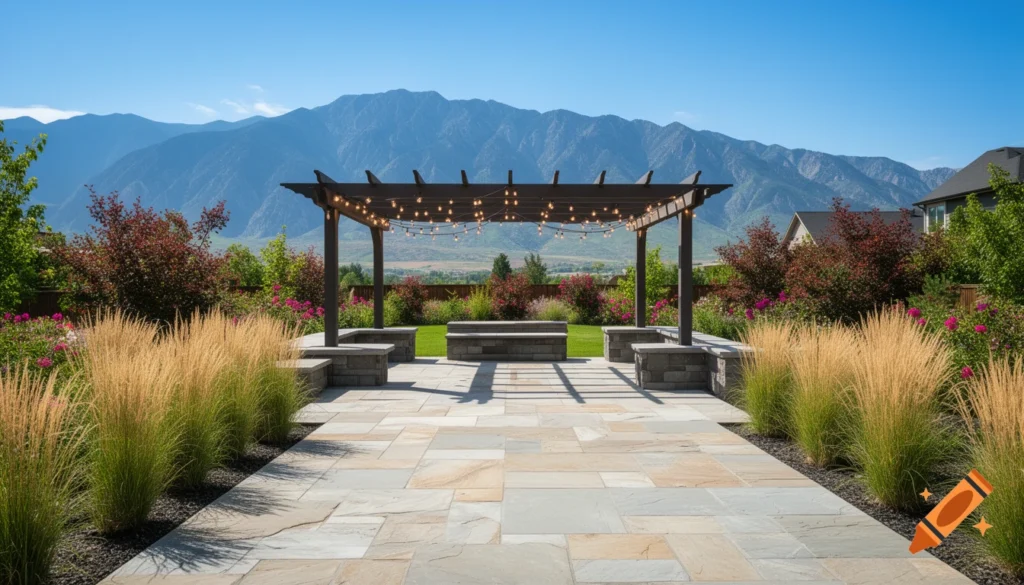
One of the biggest benefits of a well-executed slope design is the creation of usable outdoor space that previously felt unusable. Terraced retaining walls transform a steep backyard into a series of flat areas that can accommodate patios, garden beds, lawn panels, fire pit areas, or play spaces.
Designers use the topography of your lot as an opportunity rather than an obstacle. A slope that drops six feet from your back door to your rear fence line might become a two-level entertaining space with a built-in seating wall, a lower lawn area for kids, and a planted slope between them that requires minimal maintenance.
This kind of transformation is exactly why Bluffdale homeowners who invest in professional landscape design on sloped properties often see significant increases in both property enjoyment and resale value. A graded, designed, and planted slope is a feature — not a liability.
Ready to Get a Plan for Your Bluffdale Property?
Millburn Lawn & Landscape has the experience, local know-how, and crew to handle any slope, retaining wall, or grading challenge in the Salt Lake Valley.
Call or text us today for a FREE on-site estimate.
Visit: millburnlawnandlandscape.com | Serving Bluffdale, Herriman, South Jordan & beyond
Frequently Asked Questions
Q: How do I know if my Bluffdale yard needs a retaining wall or just better grading?
A: If your slope is actively eroding, shifting, or washing soil onto your patio or lawn, a retaining wall is likely necessary. Grading improvements alone work best for gentle slopes under two to three feet. A site assessment from a local landscape designer will give you a definitive answer for your specific property.
Q: How much do retaining walls typically cost in Bluffdale, Utah?
A: Costs vary significantly based on wall height, length, material, and site conditions. In the Salt Lake Valley, natural boulder walls often run $35–$65 per square face foot, while segmental block walls typically range from $20–$45. Engineered systems for taller walls will be higher. Your best starting point is a free on-site estimate.
Q: Will a retaining wall require a permit in Bluffdale?
A: In most cases, retaining walls over four feet tall (measured from the bottom of the footing) require a permit from the City of Bluffdale. Your landscape designer should be familiar with local building codes and can guide you through the permit process if needed.
Q: What’s the best time of year to start a slope landscaping project in Bluffdale?
A: Late spring through early fall is the ideal window for most grading and retaining wall work in the Salt Lake Valley. Spring snowmelt can make slope conditions unstable early in the season, while late spring offers stable conditions and allows plants to establish before summer heat. Fall planting can also work well for native species.
Q: Can native plants really hold a slope on their own without a retaining wall?
A: On gentle slopes of less than 3:1 grade, a dense planting of deep-rooted native shrubs and grasses can absolutely stabilize soil effectively. Steeper slopes generally need structural support from walls or terracing in addition to plantings. A combination approach is almost always more effective and more beautiful than relying on either alone.
Q: How do landscape designers handle drainage from neighboring properties?
A: Experienced designers assess the full watershed affecting your lot — including runoff from adjacent properties and streets. Solutions may include interceptor swales, French drains positioned at the property line, or catch basins sized for the expected flow volume. Addressing neighbor drainage is especially important on Bluffdale properties that sit at the base of a slope.
Q: Does Millburn Lawn & Landscape serve properties throughout Bluffdale?
A: Yes — Millburn Lawn & Landscape serves residential and commercial properties throughout Bluffdale and the greater Salt Lake Valley, including Herriman, West Jordan, South Jordan, Riverton, Sandy, Eagle Mountain, Saratoga Springs, and Lehi.