
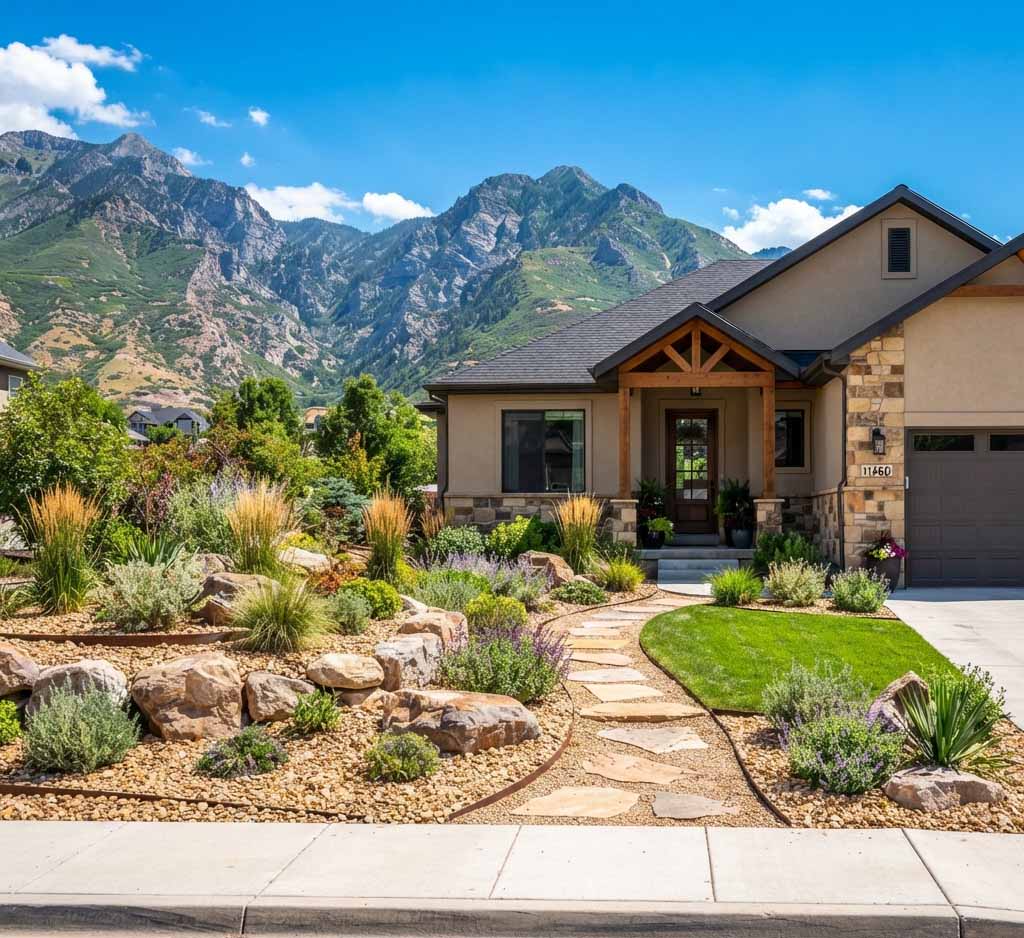
Xeriscape landscaping in Sandy, UT replaces water-hungry Kentucky bluegrass with drought-tolerant plants, inorganic mulch, and efficient drip irrigation — a design approach that can cut outdoor water use by 50–70% without turning your yard into a bare gravel lot. Sandy sits at roughly 4,400 feet in the southern Salt Lake Valley, where summer heat regularly pushes 95°F and annual precipitation runs around 16 inches. That’s a climate where traditional turf was always fighting an uphill battle. A well-designed xeriscape works with those conditions instead of against them — and in Sandy, where Jordan Valley Water Conservancy District actively offers turf-removal rebates, the timing to make that switch has never been better.
What Xeriscape Actually Means (And What It Doesn’t)
The word ‘xeriscape’ comes from the Greek ‘xeros,’ meaning dry. In practice, it refers to a landscaping method built around seven core principles: planning and design, soil improvement, appropriate plant selection, practical turf areas, efficient irrigation, mulching, and proper maintenance. It was developed in Denver in the 1980s in response to water shortages, and it translates directly to conditions in Sandy and across the Wasatch Front.
What xeriscape is not: a gravel lot with a cactus. That association persists but it’s outdated. A well-executed xeriscape in Sandy looks like an intentional, layered garden — ornamental grasses moving in the breeze, native shrubs with four-season structure, natural boulders anchoring the planting beds, and river rock in colors that complement the home and the mountains visible from almost every yard in this part of the Salt Lake Valley.
The distinguishing characteristic isn’t the absence of plants. It’s the selection of plants that have evolved to thrive in exactly the conditions Sandy offers: alkaline soil, high UV, wide temperature swings, and low consistent rainfall.
Why Sandy, UT Is a Natural Fit for Xeriscape
Sandy’s position in the southern Salt Lake Valley gives it a specific climate profile that makes traditional landscaping genuinely difficult to sustain.
Water pressure is real and increasing.
Jordan Valley Water Conservancy District, which serves much of Sandy, has maintained turf-replacement rebate programs specifically because outdoor irrigation accounts for the majority of residential water use in this region. Tiered pricing structures mean that high-use summer months hit budgets disproportionately hard. Sandy homeowners who convert even half their front lawn to xeriscape see those reductions within the first full irrigation season.
The soil works against bluegrass.
Sandy’s soil tends toward high pH and low organic content — conditions that favor native and adaptive drought-tolerant plants far more than the Kentucky bluegrass and tall fescue blends most yards were installed with. Bluegrass in this environment requires consistent fertilization, pH management, and supplemental irrigation just to stay green. The right xeriscape plants establish without that overhead and hold up through Utah winters without replacement.
Elevation and sun exposure add up.
At 4,400 feet, Sandy receives more intense UV than lower-elevation cities. That intensity accelerates evaporation from both soil and plant surfaces. A drip irrigation system that delivers water directly to the root zone — bypassing the evaporation loss of overhead spray — is one of the highest-impact changes a Sandy homeowner can make to their outdoor water budget.
The Core Elements of a Sandy, UT Xeriscape Design
A xeriscape isn’t one thing — it’s a combination of elements that work together. Here’s how Millburn approaches each component for Sandy properties:
Plant selection anchored to Utah’s climate.
The plant palette for a Sandy xeriscape draws on natives, near-natives, and proven adaptive varieties that handle alkaline soil, freeze-thaw cycles, and low supplemental water once established. Common choices include ornamental grasses like Blue Oat Grass and Karl Foerster, shrubs like Apache Plume and Russian Sage, groundcovers like creeping thyme and Autumn Joy Sedum, and small ornamental trees including Serviceberry and Amur Maple — all varieties that build root systems capable of surviving Sandy’s winters and summers with minimal support.
Inorganic mulch in planting beds.
River rock and decomposed granite outperform wood mulch in Sandy’s climate. They don’t decompose in the heat, don’t blow away in the canyon winds that funnel through the Salt Lake Valley, and suppress weeds more durably than organic alternatives. The color palette — cream, tan, warm gray — reads as natural against the Wasatch backdrop.
Boulders as structural anchors.
Natural Utah boulders do in a xeriscape what a furniture arrangement does in a room — they give the space structure, define zones, and create focal points that make the design feel intentional. For Sandy properties near the canyon mouths of Big or Little Cottonwood, large native boulders also echo the landscape immediately uphill, making the yard feel continuous with its surroundings.
Targeted turf retention.
Xeriscape doesn’t require eliminating all grass. A small accent strip near an entry walk, a play area in the backyard, or a narrow band of turf between hardscape zones can coexist with a predominantly xeriscape design. The goal is to remove turf where it struggles and design intentionally where it stays.
Drip irrigation with smart control.
Switching from overhead spray to drip delivery is one of the highest-ROI moves in any Sandy xeriscape project. Drip delivers water at the root zone, eliminates spray evaporation (which can exceed 30% on a hot July afternoon at this elevation), and allows precise zone-by-zone calibration. A weather-based smart controller adjusts schedules automatically based on local ET data, so the system responds to Sandy’s variable spring and fall conditions without manual reprogramming.
Does a Xeriscape Yard Require HOA Approval in Sandy?
Sandy has a mix of HOA-governed and non-HOA neighborhoods, and the answer varies by community. Most HOAs that govern landscaping in Sandy have updated their covenants in recent years to permit xeriscape — often in response to state-level Utah legislation discouraging HOA turf mandates. However, specific standards around mulch color, plant height, percentage of yard coverage, and boulder size may still apply.
Before beginning any xeriscape project in an HOA community, the right sequence is to pull the current CC&Rs and submit a design to the HOA’s architectural review committee for approval. A landscape contractor familiar with Sandy’s HOA landscape requirements can help prepare the submission package — drawings, plant lists, and material samples — in the format most committees expect.
The Jordan Valley Water Conservancy District’s turf-replacement rebate process also typically requires documentation that the removed turf area won’t be replaced with another type of irrigated turf. A professional installation with documentation of the new planting plan satisfies that requirement cleanly.
What the Installation Process Looks Like
A front or backyard xeriscape project in Sandy moves through a predictable sequence. An on-site design consultation establishes the scope — which areas are converting, where turf is being retained, boulder placement, plant zones, and irrigation redesign. Material selections are confirmed before ordering begins, since lead times on boulders and bulk rock vary.
Existing turf removal is typically done mechanically. Irrigation lines are reconfigured or capped for zones going to drip. The base layer of landscape fabric goes down, followed by the rock layer. Boulders are set before planting so the plant zones can be built around them.
Plants go in last, sized appropriately for the design and spaced to allow for establishment growth over the first two to three seasons. New plantings need supplemental water during their first full growing season even in a xeriscape — the low-water performance kicks in after roots establish.
Timeline from design to completion for a typical Sandy front yard: three to six weeks, depending on scope, material lead times, and permit requirements if applicable.

Millburn Lawn & Landscape designs and installs xeriscape landscapes across Sandy and the Salt Lake Valley. We know the specific plant varieties that establish well at Sandy’s elevation, the HOA approval process in the communities we work in, and how to calibrate a drip system for Wasatch Front conditions rather than a national average.
Call (801) 810-5452 to schedule an on-site consultation. We’ll walk your property, assess your current irrigation, and put together a xeriscape design plan built for Sandy’s climate — not a template.
Frequently Asked Questions
Q: Will a xeriscape yard look good year-round in Sandy?
Yes, when designed correctly. The key is choosing plants with overlapping seasonal interest — something blooming in spring, summer color, ornamental grasses for fall movement, and evergreen structural plants for winter. The hardscape elements (boulders, river rock) look the same in January as in July, so even a dormant xeriscape has visual structure that a dead bluegrass lawn doesn’t.
Q: Does Jordan Valley Water offer rebates for turf removal in Sandy?
Jordan Valley Water Conservancy District has maintained water-efficient landscape rebate programs. Requirements and availability change — visit their website directly or ask your landscape contractor to confirm current terms before beginning your project, since the rebate documentation typically needs to be submitted before the work starts.
Q: How long does it take for xeriscape plants to establish in Sandy?
Most native and drought-tolerant plants need one full growing season to develop root systems capable of surviving with minimal supplemental irrigation. During year one, supplemental watering is still necessary — typically once or twice per week during summer. By year two, most well-chosen plants in Sandy can sustain themselves with far less support.
Q: Will my HOA allow xeriscape in Sandy?
Most Sandy HOAs have updated their guidelines to permit xeriscape, partly in response to Utah legislation limiting HOA turf mandates. Standards around mulch color, plant list, and coverage percentages still vary by community. Submit a design package to your architectural review committee before starting — don’t assume approval and begin work first.
Q: What’s the difference between xeriscape and just putting down gravel?
A gravel-only yard has no plant root structure to hold soil, creates heat islands in summer, and provides no ecological value. A designed xeriscape uses gravel or river rock as mulch within planting zones that include drought-tolerant plants, boulders for structure, and drip irrigation. The visual result is a layered, intentional landscape — not a parking lot with a few rocks.
Q: How much of my lawn do I need to remove?
There’s no minimum. Some Sandy homeowners start by converting their front yard only, keeping a small backyard lawn for kids or pets. Even a partial conversion — replacing street-facing turf with xeriscape while keeping a backyard lawn — produces meaningful water savings and a substantial improvement in curb appeal.
Q: Can Millburn handle the irrigation conversion as part of the project?
Yes. Redesigning the irrigation system from overhead spray to drip is a standard part of the installation process for Sandy xeriscape projects. Millburn handles the full scope — design, plant installation, boulder and rock work, and irrigation conversion — so the system is calibrated to the new planting zones from day one.


