Outdoor Lighting in Millcreek: Why the Mature Tree Canopy Changes Everything About How You Light a Yard
The single most important thing to understand about lighting a Millcreek yard is this: the approach that works in a neighborhood with 10-year-old trees does not work here. The post-WWII neighborhoods that define most of Millcreek — Canyon Rim, Olympus Cove, East Mill Creek — carry trees that are 40 to 70 years old. Accolade elms reaching 50 feet. Honeylocusts with canopies that spread 35 feet wide. Bigtooth maples that have been throwing shade on the same patio since the 1970s. Lighting a yard with trees like those requires different fixtures, different techniques, and an understanding of what Millcreek’s own dark sky ordinance allows — and prohibits.
This guide explains why the mature canopy changes the design, what techniques actually work with large trees, what the city’s lighting code requires, and how to plan an installation that won’t damage the root systems of trees that took decades to establish.
Why Mature Trees Break Standard Outdoor Lighting Assumptions
Most outdoor lighting advice is written for newly landscaped yards: young trees, clear sightlines, simple wire routing. Millcreek yards are the opposite. A 50-foot elm has a canopy that starts 15 feet off the ground and spreads wider than most houses. A standard ground-level uplight aimed at the trunk base has almost no effect — the beam hits the lower trunk and disappears into darkness before it reaches anything interesting. The canopy overhead catches almost none of it.
The density problem works differently than most homeowners expect. In summer, a mature deciduous tree has a canopy so thick it absorbs and scatters ground-level uplights before they create any visible effect from the house. In winter, the same bare tree is actually an excellent uplight subject — but now the design has to work for both states, which is a different calculation than designing for one.
The root system adds a physical constraint that young-tree yards don’t have. The critical root zone of a mature tree extends roughly 1.5 feet for every inch of trunk diameter. A 20-inch-diameter elm — common in Canyon Rim — has a protected root zone reaching 30 feet out from the trunk. Running wire through that zone requires routing around it, using conduit rather than direct burial, or working above-grade under mulch. The standard landscape lighting install of “trench to the fixture” isn’t appropriate within this zone.
Millcreek’s Dark Sky Ordinance — What It Prohibits (and Why That’s Actually Good News)
Millcreek adopted Chapter 18.68 of its municipal code — a formal dark sky lighting ordinance — as part of its transition to cityhood. The ordinance has direct implications for residential outdoor lighting:
- All outdoor fixtures must be fully shielded and direct light downward. No light spillage above the horizontal plane.
- Color temperature is capped at 3,000 Kelvin for most outdoor applications.
- Uplighting is prohibited under the ordinance, with limited exceptions.
- Security lighting must be motion-activated and limited in duration.
The uplight prohibition is the one most homeowners don’t know about. The typical vision of landscape lighting — a spotlight buried at the base of a tree, beam aimed straight up — is not permitted in Millcreek. For most yards, this isn’t a loss. It’s actually a push toward techniques that look better with mature trees anyway.
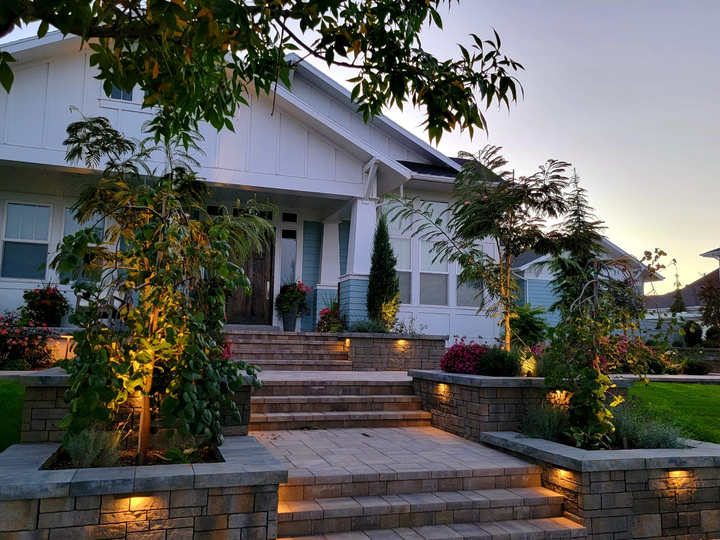
The good news: downlighting and moonlighting — the techniques that work best with Millcreek’s large tree canopies — are fully compliant. Light directed from above, downward through a canopy, stays below the horizontal plane. It aligns with both the ordinance and the aesthetic reality of how large trees interact with light.
Moonlighting: The Technique Mature Canopies Were Built For
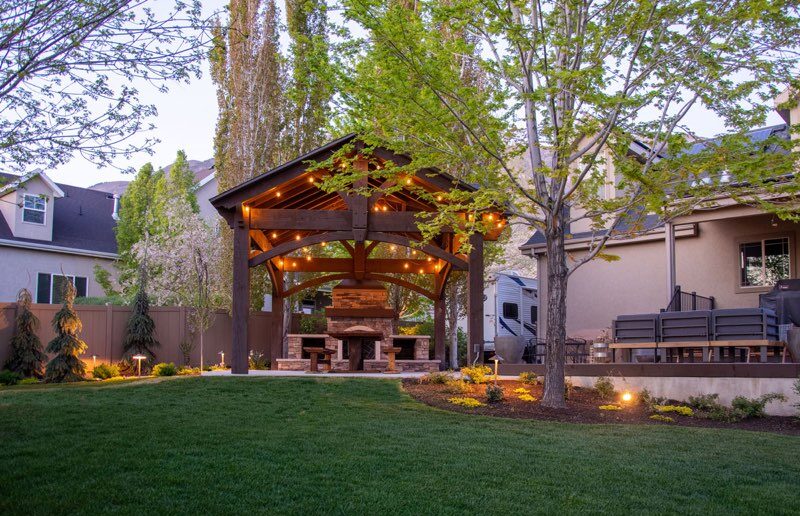
Moonlighting is the practice of mounting fixtures high in a tree — typically 20 to 30 feet up — and directing the beam downward through the canopy and onto the ground below. The effect mimics natural moonlight filtering through branches: soft, shifting pools of light with organic shadow patterns that move slightly in the wind. It is arguably the most effective technique for large deciduous trees, and it’s the one that scales correctly to the canopy sizes found in Millcreek.
What makes moonlighting work is height and canopy structure. A fixture mounted at 25 feet in an elm sends light through 15 to 20 feet of branching structure before it reaches the ground. That filtering creates the dappled, layered effect that makes the yard feel like it’s lit from nature rather than staged. At the right lumen output — 230 to 270 lumens for a large canopy — the result is even ground illumination at conversation-level brightness without harsh spots.
What makes moonlighting fail in Millcreek is getting the geometry wrong. A fixture mounted too low in the canopy doesn’t benefit from the filtering distance. A fixture aimed too steeply creates a hot spot rather than a diffused pool. And the wrong color temperature ruins the effect — 2700K produces warm amber pools that feel natural; 4000K produces blue-white light that makes a Millcreek elm look like a hospital parking lot.
Moonlighting vs. Other Techniques for Large Trees
For Millcreek’s mature tree inventory, these techniques work in descending order of effectiveness:
- Moonlighting (in-canopy downlight): Best for large deciduous trees — elm, honeylocust, zelkova, bigtooth maple. Requires professional installation at height. Fully ordinance-compliant.
- Downlighting from structures: Fixtures mounted on rooflines, pergolas, or tall fence posts directed down through adjacent tree canopy. Works where in-tree mounting isn’t practical. Ordinance-compliant.
- Path and ground lighting under canopy: Low fixtures illuminating the ground plane beneath established trees. Doesn’t light the tree itself, but defines the space. Fully compliant and practical for DIY installation.
- Silhouetting: Placing a light source behind a tree against a light-colored wall or fence to create a silhouette outline. Works for smaller ornamental trees; less effective at Millcreek’s canopy scales.
- Uplighting: Prohibited under Millcreek’s ordinance for most residential applications.
Fixture Selection for Utah’s Freeze-Thaw and Alkaline SoilFixture Selection for Utah’s Freeze-Thaw and Alkaline Soil
A Millcreek-specific lighting installation has to survive conditions that affect fixture longevity differently than milder climates. Salt Lake County’s frost depth reaches 30 inches — wire buried at the typical DIY depth of 6 to 8 inches is in freeze-heave territory. Conduit rather than direct-burial wire is the right spec for any runs that cross root zones or turf areas where annual frost movement is predictable.
Utah soils run alkaline — statewide average around pH 8.0. That chemistry is hard on fixture components in soil contact. Copper and bronze are the most durable materials for ground-level fixture bodies and stakes. Brass can be used for above-grade components but is prone to dezincification (zinc leaching out) in Utah’s wet spring conditions. Aluminum corrodes faster here than in neutral-pH regions. For fixtures that will sit in or near soil for years, material selection matters more than it does in coastal markets where the soil chemistry is more forgiving.
Color temperature: Millcreek’s ordinance caps outdoor lighting at 3,000K, which aligns with the 2,700K to 3,000K range that produces the warmest, most natural light in a landscape setting. For deciduous trees with fall color — bigtooth maple in particular — 2,700K is the correct spec. Cooler temperatures kill the orange and amber tones that make fall lighting in Millcreek worth doing.
The Millcreek Trees Worth Lighting
Not every tree in a Millcreek yard rewards the investment of a well-designed lighting plan. These species, common in established Millcreek neighborhoods, produce the strongest results:
Accolade Elm and Village Green Zelkova
Both reach 50 to 60 feet at maturity with vase-shaped canopies that spread wide. The vase form means the canopy starts relatively high and fans outward — ideal for moonlighting because the fixture can be placed at the inflection point where the canopy opens and the downlight benefits from the full spread. In Canyon Rim and similar neighborhoods, these are often the largest trees on the property.
Quaking Aspen
White bark is one of the best lighting subjects in the Wasatch Front landscape. Grazing light across the trunk surface — a narrow-beam fixture aimed along the bark rather than at it — creates texture and dimension that moonlighting alone doesn’t achieve. Aspens in Millcreek’s foothill neighborhoods often grow in clusters, which amplifies the effect. Note: aspens spread by root suckers and their root systems are aggressive — plan wire routing accordingly.
Bigtooth Maple
The native Utah maple that turns orange-red in October. At 20 to 30 feet, it’s the right scale for a combination approach: moonlighting for the canopy effect in summer, and carefully placed path lights that catch the ground-level color during fall. The 2,700K spec is non-negotiable for fall maple lighting — cooler temperatures produce gray-orange rather than the saturated amber the species is capable of.
Shademaster Honeylocust
Fine, compound leaves create a filtering effect that suits moonlighting well — the canopy is dense enough to produce pattern but open enough that the ground light distribution stays even rather than fully blocked. The winter silhouette, with strongly angled branching structure, is one of the better bare-tree lighting subjects in Millcreek’s common species inventory.
────────────────────────────────────────────────────────────────────
Planning the Installation: What to Do Before Any Wire Goes in the Ground
A lighting design for a mature Millcreek yard should start with a site walk at dusk — not a product selection or a wattage calculation. The goal of the site walk is to identify where light is already happening naturally (ambient from streetlights, the moon, neighbor properties) and where the yard goes completely dark. Those dark zones are where the design works hardest.
Map the root zones before planning wire routes. Locate the trunk of each significant tree, estimate the diameter, and mark the protected root zone radius. Wire routes should run around the perimeter of that zone, not through it. Where fixture placement inside the zone is unavoidable, above-grade routing under mulch is preferable to trenching.
Millcreek’s ordinance should shape fixture selection from the start, not be added as a compliance check at the end. Choosing fully shielded, downward-directed fixtures in the 2,700K–3,000K range means the design is already compliant rather than requiring retrofits after installation. For any project that involves a permit — additions, significant landscape renovations — confirm the lighting plan with Millcreek’s planning department before installation.
For a yard with significant specimen trees, a consultation with Millburn Lawn & Landscape before installation is worthwhile. The combination of landscape design knowledge, root zone awareness, and lighting design produces a result that works with the trees rather than around them — and avoids the installation mistakes that damage root systems or require expensive fixture relocations as trees grow.
Ready to light your Millcreek yard the right way?
Millburn Lawn & Landscape | (801) 810-5452 millburnlandscape.com | Serving Millcreek and all of Salt Lake County
FREQUENTLY ASKED QUESTIONS
Does Millcreek allow uplighting on trees?
Millcreek’s dark sky ordinance (Chapter 18.68) prohibits uplighting for most residential applications. The ordinance requires fully shielded, downward-directed fixtures. Moonlighting — fixtures mounted in the tree and aimed downward — and downlighting from structures are the compliant alternatives, and both produce better results with Millcreek’s large mature trees anyway.
What color temperature is required for outdoor lighting in Millcreek?
Millcreek’s ordinance caps outdoor lighting at 3,000 Kelvin. In practice, 2,700K to 3,000K warm white LEDs are the correct spec for residential landscape lighting. This range is also the best aesthetic choice for Millcreek’s tree canopy and fall foliage — cooler temperatures produce unnatural blue-white light that works against the landscape rather than with it.
How does moonlighting work and why is it better for large trees?
Moonlighting places fixtures high in the tree canopy — typically 20 to 30 feet up — and directs the beam downward through the branches onto the ground. The filtering effect of branching structure creates soft, layered pools of light with organic shadow patterns. It scales correctly to large tree canopies where ground-level uplighting would have almost no visible effect. It’s also the technique that mimics how natural moonlight looks in a mature tree yard, which is why it reads as ambient rather than staged.
Can I run wire under a large tree without damaging the roots?
Not with a standard trench. The critical root zone of a mature tree extends approximately 1.5 feet for every inch of trunk diameter — a 20-inch elm has a 30-foot protected radius. Machine trenching through this zone cuts roots and can permanently damage or kill the tree. Wire routes should go around the root zone perimeter, or use above-grade routing under mulch for shorter runs near the trunk. For complex installs near specimen trees, an arborist consultation is worth the investment.
What fixture materials hold up in Utah’s alkaline soil?
Copper and bronze are the most durable choices for fixture components in soil contact. Utah soils run around pH 8.0, which accelerates corrosion in aluminum and causes dezincification in brass in wet conditions. For any fixture body or stake that will have extended soil contact, copper or bronze is the right specification. Gel-filled waterproof connectors are also important — Utah’s freeze-thaw cycle loosens standard push-connectors over time, creating voltage drop and connection failures.
How many fixtures does a large Millcreek elm or zelkova need?
For a large shade tree in the 50 to 60-foot range, plan for three to four fixtures to avoid the single-bright-spot effect. Two to three moonlighting fixtures placed at different heights and angles within the canopy produce overlapping, graduated light across the full canopy spread. A single fixture aimed at the trunk creates what lighting designers call the bonfire effect — one harsh bright spot rather than canopy-wide illumination.
Is a permit required for outdoor lighting installation in Millcreek?
Low-voltage landscape lighting (12V systems) typically doesn’t require a permit for standard residential installation. Line-voltage systems require a licensed electrician and permit. If the lighting is part of a larger landscape project that itself requires a permit — grading, new hardscape, significant additions — the lighting design should be included in the permit package. For dark sky ordinance compliance in a permitted project, confirm the fixture specs with Millcreek’s planning department before finalizing the design.