The Lot Size Problem Nobody Mentions When You Buy in Millcreek
Millcreek is one of the most desirable zip codes in Salt Lake County for good reason. Walkable streets, mature tree canopy, proximity to Mill Creek Canyon, an established neighborhood character that the valley’s newer suburbs are still trying to build from scratch. What the listing sheet does not emphasize is that most Millcreek lots are small by Utah suburban standards — many in the 5,000 to 8,000 square foot range, with the house taking up a significant portion of that.
Then you close, move in, and walk out the back door for the first time. The yard that looked adequate in the photos feels more constrained than you expected. The neighbor’s fence is closer than you thought. The mature trees that sold you on the neighborhood are also shading half the usable space. The driveway and the house together leave a backyard that seems like it should feel generous but somehow does not.
This is not a problem unique to Millcreek — it happens across Salt Lake City’s urban core and the older neighborhoods along the Wasatch bench — but Millcreek has a particularly high concentration of homeowners who experience it. And it has a solution that most of them never discover because it requires a counterintuitive design approach.
The yards in Millcreek that feel twice their actual size are not that way by accident. They were designed to feel that way.
Why Small Yards Feel Small and Why That Is a Design Problem, Not a Square Footage Problem
The human eye does not experience a yard by measuring it. It experiences it by reading the cues the design sends about how far space extends, how much there is to discover, and how deliberately each element was placed. A small yard designed without intention feels like exactly what it is: a constrained leftover between a house and a fence. The same square footage designed with intention reads as a complete outdoor room — bounded, purposeful, and surprisingly generous.
The design errors that make small Millcreek yards feel smaller than they are fall into a consistent set of patterns. Solving them does not require adding square footage. It requires changing how the existing square footage is read.
Error 1: One Undivided Space
The most common mistake in small Millcreek backyards is treating the entire rear yard as a single zone — one lawn area, or one patio, or one undivided expanse — with no internal organization. The result reads as a single small space because it is a single small space. There is nothing to discover and no sense that the yard has any depth beyond its literal dimensions.
The counterintuitive fix: divide the space. Two or three defined zones — a dining area, a garden zone, a small lawn panel or secondary seating pocket — make the same yard feel larger because the eye has somewhere to travel. The brain reads distinct zones as more space than one undivided area of equal total size.
Error 2: Planting at the Wrong Scale
Small yards in Millcreek’s established neighborhoods often have the opposite of the scale problem you might expect. Rather than having plants that are too large, they frequently have too many small individual specimens planted without a coherent composition. The effect is visual clutter that shrinks the perceived space.
Mass planting — grouping the same species in dense, deliberate drifts rather than spotting individual plants — creates visual simplicity that makes a small yard read as calm and spacious rather than busy and cramped. Three lavenders planted together read as one intentional gesture. Three different single specimens at the same spacing read as indecision.
Error 3: Parallel Lines
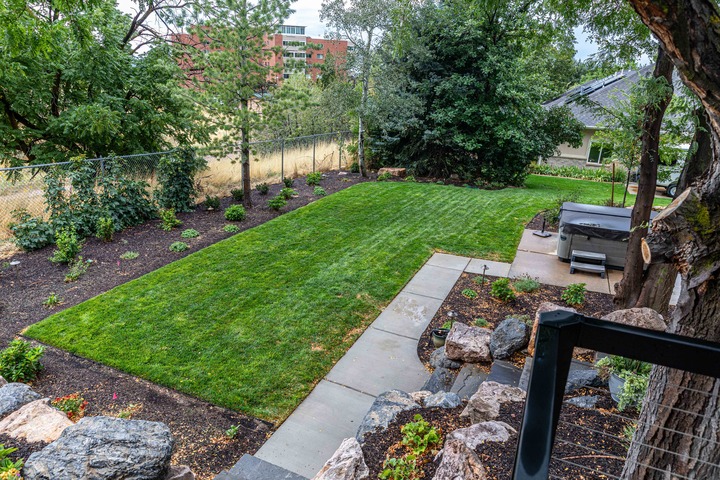
Most Millcreek yards are rectangular, and most rectangular yards are landscaped with elements that run parallel to the fence lines — a lawn strip along one side, a planting bed along the back, a patio running parallel to the house. These parallel lines reinforce the rectangular shape and make the yard feel exactly as bounded as it is.
Diagonal design lines — a pathway that cuts across the yard at a 45-degree angle, planting beds with angled rather than square-cut edges, a patio positioned at a slight angle to the house — break the rectangular reading and create a sense of depth that does not exist in the literal dimensions. It is one of the oldest techniques in residential landscape design and it works consistently on Millcreek’s constrained lots.
The Techniques That Make Millcreek Yards Read Larger
Borrowed Landscape: Using What Is Beyond Your Fence
Millcreek’s mature urban tree canopy is one of the city’s defining characteristics — and it extends well beyond any individual property line. Mature trees in neighboring yards, the canyon canopy visible along the lower Mill Creek Canyon corridor to the east, the established street trees lining Millcreek’s residential blocks — all of this exists just beyond the fence and can be incorporated into the visual experience of your yard without requiring you to own any of it.
Borrowed landscape is the design practice of positioning sight lines and planting compositions to include adjacent landscape elements in the visual field of your property. A planting bed that frames a view toward a neighbor’s mature oak rather than screening it. A seating area positioned to look toward the street trees rather than at the fence. A pathway that leads the eye toward the canyon canopy above the roofline. The yard you see becomes larger than the yard you own.
Vertical Interest Without Horizontal Footprint
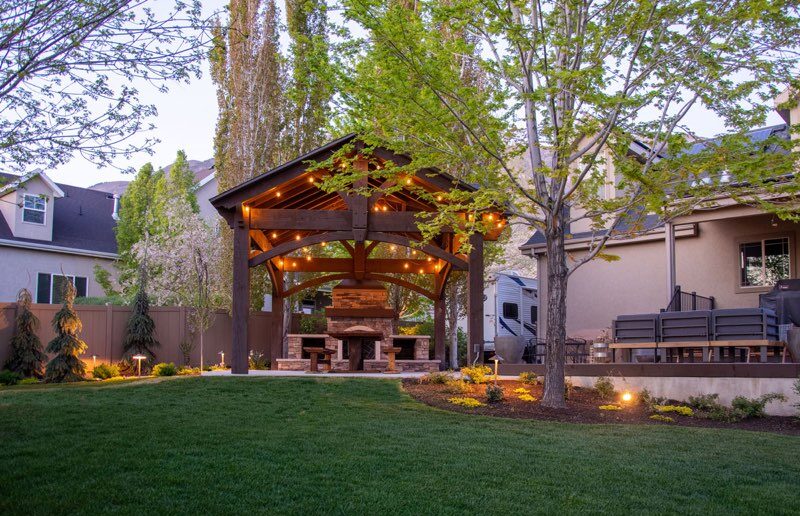
Small Millcreek yards cannot afford to put everything in the ground plane. The solution is to move interest and function to the vertical plane. A pergola with hanging planters adds overhead texture and planting mass without consuming patio square footage. A fence panel with wall-mounted planters converts a boundary into a garden feature. Columnar plant forms — Sky Pencil Holly, columnar serviceberry, ornamental grasses that grow up rather than out — add height and presence without the spreading footprint of conventional shrubs.
Vertical elements also have a specific psychological effect on small spaces: they make the space feel enclosed in an intentional way rather than cramped. The difference between a small Millcreek yard that feels like an outdoor room and one that feels like a leftover is largely the presence of deliberate vertical structure.
Layered Planting Depth
A single layer of planting along a Millcreek fence line — a row of shrubs at the same height — reads flat and adds nothing to the perceived depth of the space. Layered planting creates a sense of depth within the bed itself that translates into perceived depth for the whole yard.
In Millcreek’s zone 7a conditions, a well-layered planting palette might include Creeping Thyme or Sedum at the front edge, Salvia or Penstemon at mid-height, a compact ornamental grass like Karl Foerster behind them, and a multi-stem Serviceberry as the back layer. The total bed width might be six feet. The perceived depth it creates reads significantly greater.
Hardscape Sized for How the Space Will Actually Be Used
One of the clearest signals of an intentionally designed small yard is hardscape scaled correctly for actual use. This sounds obvious, but it is consistently violated in Millcreek yards: a patio too small to fit a dining table and four chairs comfortably, a pathway so narrow that two people cannot walk side by side. Under-scaled hardscape makes a small yard feel like it is apologizing for its size.
A correctly scaled patio in a small Millcreek backyard — large enough to seat the household with comfortable clearance around the furniture — anchors the space and makes everything around it feel organized. The counterintuitive rule: a larger patio in a small yard usually makes the yard feel bigger, not smaller. It defines where outdoor living happens and lets the planting read as intentional framing rather than competing with usable space.
Working With Millcreek’s Mature Tree Canopy
The mature trees in Millcreek’s established neighborhoods are both the best feature of many properties and the most common complicating factor in small yard design. Deep shade, root competition, and the visual dominance of a large established tree all change how a small yard can be organized — but they change it in ways that are manageable once understood.
Under a large deciduous canopy, shade-tolerant planting — Astilbe, native ferns, Epimedium, Hostas where deer pressure is manageable — can create a lush garden layer that would be impossible in a full-sun yard. The shade itself, which most Millcreek homeowners initially treat as a problem, becomes an asset in a climate where summer afternoons regularly exceed 95 degrees. A small shaded Millcreek backyard that is comfortable at 3 p.m. in August offers something many larger yards in the newer suburbs cannot match.
Root zones require care: avoid paving within the critical root zone, use permeable surfaces like decomposed granite where hardscape must coexist with significant roots, and plant at the canopy edge rather than directly beneath where competition for water and nutrients is highest.
What This Means for Landscape Design in Millcreek
The design approach for a Millcreek lot is fundamentally different from the approach for a new construction lot in Eagle Mountain or Herriman. The questions are different. Instead of ‘what should fill this space,’ the question is ‘how should this space be organized.’ Instead of a blank slate, the designer is working with existing conditions — mature trees, established neighborhood character, lot proportions that require deliberate choices to read well.
This is why Millcreek landscape design benefits more than most from a professional design process before any installation begins. The decisions that make a small yard feel large — zone division, diagonal lines, borrowed landscape orientation, planting layer composition, hardscape sizing — are design decisions, not installation decisions. They need to be resolved before anything is built, because the whole approach depends on each element relating to every other element in a coherent way.
A small Millcreek yard designed from a coherent plan looks completely different from the same yard where each element was added incrementally. That difference is what makes some Millcreek backyards stop visitors while others go unnoticed despite sitting on identical lot sizes.
Design Your Millcreek Yard to Feel Like More
Millburn’s landscape design team works with the constraints of Millcreek’s established urban lots mature trees, smaller footprints, and older neighborhoods that reward intentional design over afterthought installation.
Call (801) 810-5452 or visit millburnlandscape.com to schedule your Millcreek landscape design consultation.
Frequently Asked Questions
What lot size is typical in Millcreek, Utah?
Millcreek’s established residential neighborhoods have lot sizes that vary, but many fall in the 5,000 to 8,000 square foot range — smaller than the newer suburban developments in South Jordan, Herriman, or Eagle Mountain. This reflects Millcreek’s origins as one of Salt Lake County’s denser, mid-century urban communities.
Can landscape design really make a small Millcreek yard feel larger?
Yes — consistently. The techniques that create perceived spatial expansion work because they change how the eye reads the space rather than changing the space itself. A well-designed small yard is experienced as more generous than a larger yard without intentional design. Zone division, diagonal lines, layered planting, borrowed landscape, and correctly scaled hardscape are all well-established tools for this.
How do you landscape around mature trees in a small Millcreek yard?
Work with the tree’s conditions rather than against them. Use shade-tolerant species at the canopy edge, avoid paving within the critical root zone, and treat the shade as a summer comfort asset rather than a problem to eliminate. Permeable surfaces like decomposed granite work well where hardscape must coexist with established roots.
What is borrowed landscape and how does it apply to Millcreek?
Borrowed landscape is incorporating elements beyond your property line — neighboring trees, the canyon canopy, street trees — into the visual composition of your yard. In Millcreek, with its mature urban canopy and Mill Creek Canyon to the east, there is often significant borrowed landscape available if the design deliberately orients toward it. The result is a yard that feels connected to a larger landscape rather than enclosed behind its own fence.
Does Millburn Lawn & Landscape do landscape design in Millcreek?
Yes. Millburn Lawn & Landscape provides landscape design services throughout Millcreek and Salt Lake County, including work on established urban lots with mature trees and the constrained proportions common in Millcreek’s residential neighborhoods. Call (801) 810-5452 or visit millburnlandscape.com to schedule a consultation.