Why Plants Fail in Herriman — and How to Make Sure Yours Do Not
There is a familiar disappointment that many Herriman homeowners know well: a plant that looked healthy and vibrant at the nursery, installed with care and good intentions, that struggles through its first season and does not make it to its second. It is frustrating, it is expensive, and in a climate as specific as Herriman‘s, it is almost always preventable.
The truth is that long-term plant survival in Herriman is not a matter of luck or a green thumb. It is a matter of making the right decisions at three critical stages: selecting plants genuinely adapted to Herriman’s conditions, installing them correctly for the site, and supporting them through the establishment period with appropriate care. Get those three stages right and your plants will not merely survive — they will thrive for decades with minimal intervention.
This guide walks through each stage in depth, with specific guidance for Herriman’s unique combination of high-altitude UV, alkaline soils, low annual rainfall, and dramatic seasonal temperature swings. Whether you are planning a new landscape installation or trying to understand why existing plants are underperforming, these principles apply directly.
Stage One: Selecting Plants Built for Herriman’s Conditions
Long-term plant survival begins before any plant touches the ground. Species selection is the single most powerful lever a Herriman homeowner has for determining long-term landscape success — and it is where the most consequential mistakes are made.
Understand Herriman’s Specific Growing Constraints
Herriman presents a specific combination of growing conditions that eliminates a significant portion of otherwise attractive landscape plants:
- USDA Hardiness Zone 7a: Minimum winter temperatures of 0 to 5 degrees Fahrenheit. Plants labeled as zone 7b or warmer are at significant winter kill risk in Herriman, particularly in exposed locations and colder microclimates near the Oquirrh foothills.
- Soil pH 7.5 to 8.5 (alkaline): Herriman’s soils are moderately to strongly alkaline. Acid-loving plants — Rhododendron, Azalea, Gardenia, Blueberry — will develop iron chlorosis, fail to absorb essential nutrients, and decline regardless of irrigation and fertilization.
- Annual rainfall of 15 to 17 inches: Most of Herriman’s precipitation falls as winter snow. Summer irrigation is essential for plant establishment, but long-term plant selections should target low-to-moderate water needs to remain viable through drought years and water restrictions.
- High UV at 4,900 to 5,400 feet: UV intensity in Herriman is 20 to 25% higher than at sea level. This stresses plants more rapidly than lower-elevation gardens, particularly in their first summer before root systems are fully established.
- Clay-heavy soils: Many Herriman properties have high clay content, which drains slowly, compacts easily, and creates challenging conditions for plants that require good drainage. Species tolerant of clay soils are significantly more likely to establish and persist.
The Selection Hierarchy for Herriman Plants
When selecting plants for long-term success in Herriman, apply this hierarchy in order: plants confirmed to thrive in zone 7a, then plants confirmed to tolerate alkaline soils, then plants confirmed to handle low-to-moderate water once established. A plant that meets all three criteria is a strong Herriman performer. A plant that fails any one of these criteria is a long-term risk.
Plants native or adapted to the Intermountain West region — Gambel Oak, Serviceberry, native Penstemons, Blue Grama Grass, and Rabbitbrush — inherently satisfy all three criteria and deserve far more use in Herriman landscapes than they currently receive. They have evolved for exactly these conditions and will outperform exotic alternatives in long-term establishment and drought resilience.
Stage Two: Installing Plants for Long-Term Root Success
Even the best-selected plant can fail if installed incorrectly. In Herriman’s specific soil and climate conditions, a handful of installation decisions have outsized impact on long-term plant survival.
Planting Depth: The Most Common Installation Error
Planting too deep is the single most common cause of otherwise healthy plant failure in residential landscapes — including Herriman. The root flare, the point where the trunk meets the roots at the base of the plant, should be at or very slightly above the finished soil grade. Burying the root flare even two to three inches encourages crown rot, girdling root development, and bark disease — all of which are slow killers that may not manifest visibly until two to four years after installation.
In Herriman’s clay soils, which drain slowly and can hold moisture at depth for extended periods, plants installed too deep are at particular risk of crown and root rot during the wet periods following spring snowmelt and summer irrigation.
Soil Amendment: When and How Much
The instinct to heavily amend Herriman’s clay soils with organic matter before planting is understandable but requires careful execution. Heavily amending only the planting hole while leaving surrounding native soil unchanged creates a bowl effect — water migrates into the amended hole and saturates it, while roots that reach the amendment boundary are reluctant to extend into the denser surrounding clay. This produces a root system permanently confined to the planting hole rather than extending into the landscape.
A better approach for most Herriman plantings is to amend broadly and shallowly across the entire planting bed area — working 2 to 3 inches of quality compost into the top 8 to 10 inches of existing soil across the full installation zone — rather than deep amendment of individual holes. This creates a gradual transition that encourages root extension into the broader landscape.
Mulching for Moisture Retention and Soil Health
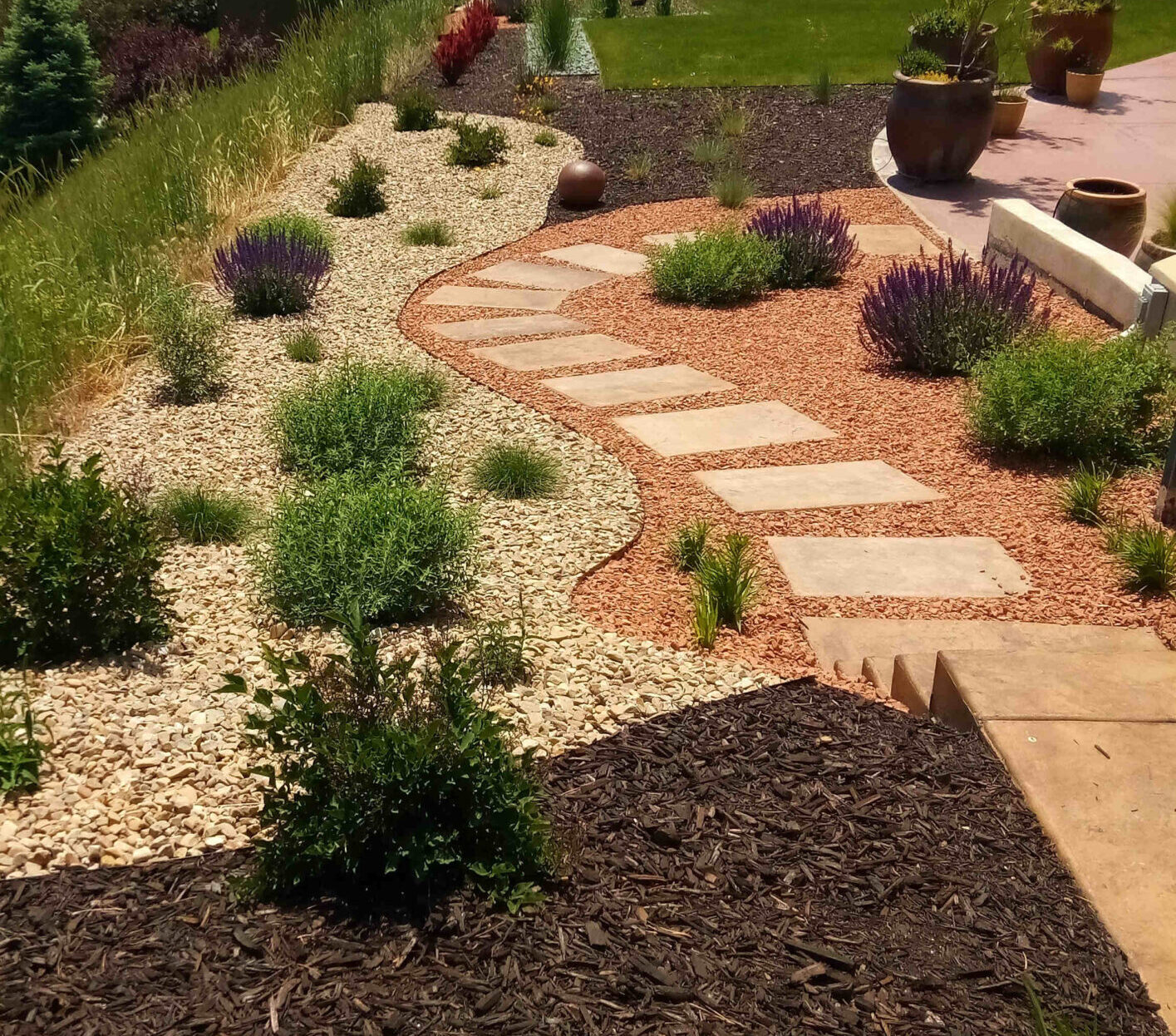
A 3 to 4 inch layer of organic mulch — wood chips, shredded bark, or composted wood — applied over the root zone of newly installed plants is one of the highest-return investments in long-term plant survival for Herriman landscapes. Mulch moderates soil temperature swings that Herriman’s dramatic seasonal extremes would otherwise impose directly on root systems, retains soil moisture between irrigation cycles, suppresses competing weeds, and gradually improves soil structure as it decomposes. Keep mulch pulled back 2 to 3 inches from the trunk or stem base of all plants to prevent the moisture and fungal conditions that promote crown rot — particularly important in Herriman’s alkaline, slow-draining soils.
Stage Three: Supporting Establishment — The Critical First Three Years
Plant establishment in Herriman — the period during which a newly installed plant develops root systems sufficient to support itself without supplemental irrigation — typically takes one to three full growing seasons depending on the plant’s size and species. Most long-term plant failures in Herriman occur during or immediately after this establishment window, not because the plant was poorly selected, but because establishment support was withdrawn too early.
Irrigation During Establishment
New plantings in Herriman require regular deep watering during the establishment period regardless of their long-term drought tolerance. A plant listed as drought-tolerant once established still needs consistent moisture while its root system is developing — and in Herriman’s low-humidity, high-UV summer environment, that means watering every 3 to 5 days for the first full summer season for most species.
Deep, infrequent watering consistently outperforms shallow, frequent watering for plant establishment in Herriman. Deep watering — applying enough water to penetrate 12 to 18 inches into the soil — encourages roots to follow moisture downward, developing deep root systems that access subsurface moisture during dry periods. Shallow, frequent watering trains roots to stay near the surface, where they are most vulnerable to drought stress.
Winter Protection for Newly Installed Plants
Herriman’s winters are cold enough — with temperatures regularly dropping to 0 to 5 degrees Fahrenheit — that newly installed plants with incompletely established root systems face genuine winter stress even from species rated as hardy to zone 6. Newly installed broadleaf evergreens such as Mahonia and some Holly varieties benefit from burlap windscreen protection during the first one to two winters, shielding them from the desiccating winter winds that Herriman’s Oquirrh Mountain exposure can deliver.
Applying a fresh layer of mulch in late October, before the ground freezes, insulates root systems through Herriman’s coldest nights — a low-effort step that meaningfully improves winter survival rates for newly installed plants.
Monitoring and Early Intervention
Newly installed plants in Herriman should be observed regularly through both the first full summer and first winter. Early signs of stress — leaf curl, premature yellowing, dieback at branch tips — are far easier to address when caught early than when a plant has been struggling unobserved for weeks. Common early problems in Herriman new plantings include iron chlorosis from alkaline soils (yellowing leaves with green veins), drought stress from insufficient establishment irrigation, and root disturbance from frost heaving in clay soils.
Plant Long-Term Success Quick Reference for Herriman, Utah
Use this table as a planning checklist for any new plant installation in Herriman.
| Success Factor | What to Check | Herriman Risk | Solution |
| Zone hardiness | Zone rating on plant tag | Zone 7b+ plants may winter kill | Verify zone 7a or colder tolerance |
| Soil pH tolerance | USU Extension or Plant Select | Alkaline pH 7.5-8.5 causes chlorosis | Choose alkaline-adapted species |
| Planting depth | Root flare location at install | Too-deep planting causes crown rot | Root flare at or above grade |
| Soil amendment | Hole vs. broad-area amendment | Bowl effect traps water in clay | Amend broadly, not just the hole |
| Mulch depth | Thickness and clearance from stem | UV and heat accelerate decomposition | 3-4 in. organic; refresh annually |
| Establishment watering | Deep vs. shallow irrigation | Early drought kills or weakens roots | Deep water every 3-5 days year one |
| Winter protection | Exposure and species hardiness | Desiccating winds damage evergreens | Burlap screen + fall mulch refresh |
Plant Once, Enjoy for Decades — Let Us Help You Get It Right
Long-term plant survival in Herriman is not guesswork. It is careful selection, correct installation, and expert establishment support — all grounded in deep knowledge of this specific climate. Our Herriman landscape team ensures every plant we install has the strongest possible foundation for lasting success.
Book Your Free Plant Selection and Landscape Design Consultation Today
Frequently Asked Questions
Q How long does it take for plants to establish in Herriman, Utah?
Most landscape plants require one to three full growing seasons to establish in Herriman — meaning their root systems are sufficiently developed to support the plant through summer drought without supplemental irrigation. Larger balled-and-burlapped trees take longer than smaller container-grown plants. Do not withdraw establishment irrigation support until you have observed the plant thriving through at least two consecutive dry summer periods without intervention.
Q Why do my plants keep getting yellow leaves in my Herriman yard?
Yellowing leaves with green veins — a condition called iron chlorosis — is one of the most common plant problems in Herriman and is caused by the area’s alkaline soils limiting iron availability to plants. Acid-loving species are most susceptible and should be avoided altogether in Herriman landscapes. For susceptible plants already in the ground, chelated iron supplements can provide temporary relief, but the long-term solution is replacing them with alkaline-tolerant species.
Q What is the best time of year to plant in Herriman, Utah?
Fall planting — September through October — is consistently the most successful establishment window for Herriman landscapes. Soil temperatures are still warm enough for root growth, air temperatures have moderated from summer’s UV stress, and plants have the entire winter and spring to establish roots before facing their first full summer growing season. Spring planting in April and May is the second-best option. Avoid planting during Herriman’s hottest summer months unless you can commit to intensive establishment irrigation.
Q Do I need to amend Herriman’s clay soil before planting?
For most new plantings, broad shallow amendment of the entire bed area is more beneficial than deep amendment of individual planting holes. Incorporating 2 to 3 inches of compost across the full planting zone improves drainage and soil structure while avoiding the bowl effect that traps water in deeply amended individual holes surrounded by dense clay. For plants genuinely intolerant of clay, raised bed installations may be a better long-term solution than in-ground planting.
Q How do I protect newly planted trees and shrubs from Herriman’s winter?
For newly installed broadleaf evergreens and marginally hardy shrubs, a burlap windscreen supported by stakes provides effective protection from Herriman’s desiccating winter winds. Apply a fresh 3 to 4 inch layer of organic mulch over the root zone before the ground freezes to insulate roots through the coldest nights. Avoid plastic wrapping, which can trap moisture and create conditions for fungal disease.